
Network Segmentation: What It Is, Why It Matters, and How to Do It Right

Updated: Sep 16

Overview | Network Segmentation
If you imagine your network as a single open room where every device can talk to every other device, you can probably see the problem: one compromised machine can potentially reach everything. Network segmentation fixes that. Instead of one big flat network, you break it into smaller, controlled sections. Each section has rules about what it can access and how it communicates.
This is one of the most practical, high-impact security and performance strategies you can implement, whether you run a small office or a large enterprise network.
What Is Network Segmentation?
Network segmentation is the practice of dividing a network into smaller, isolated segments or zones. In simple terms: It’s about controlling who can talk to whom inside your network.
Each segment can have its own:
Access rules
Security policies
Traffic controls
This reduces risk and improves visibility.
Why Network Segmentation Is Used
A flat network is easy to manage, but also easy to exploit. Segmentation is used to:
Limit the spread of cyberattacks
Protect sensitive systems
Improve network performance
Simplify monitoring and control
If one segment is compromised, the attacker doesn’t automatically gain access to everything else.
Key Benefits of Network Segmentation
Below are the major advantages of network segmentation that help strengthen security, optimize performance, and improve overall network control.
Improved Security
This is the biggest advantage. If malware enters your network:
It stays confined within a segment
It cannot easily spread to critical systems
👉 This is called containment.
Better Access Control
You can define exactly:
Which users access which systems
Which applications can communicate
Example:
HR systems are only accessible to HR staff
Guest Wi-Fi cannot access internal servers
Reduced Attack Surface
Instead of exposing your entire network:
Only specific segments are accessible
This makes it harder for attackers to move laterally.
Improved Performance
Segmentation reduces unnecessary traffic:
Less broadcast traffic
Better bandwidth management
Reduced congestion
Easier Monitoring and Troubleshooting
Smaller segments make it easier to:
Identify issues
Track unusual activity
Isolate problems quickly
Compliance and Regulatory Requirements
Many standards require segmentation, including:
PCI-DSS (for payment systems)
HIPAA (healthcare data)
GDPR-related best practices
Segmentation helps meet these requirements.
Types of Network Segmentation
Below are the different types of network segmentation methods used to organize, secure, and efficiently manage network traffic.
Physical Segmentation
Separate hardware for each segment
Completely isolated networks
👉 Very secure but expensive.
Logical Segmentation (Most Common)
Uses software-based methods like:
VLANs (Virtual LANs)
Subnets
Routing rules
👉 Flexible and widely used.
Microsegmentation
A more advanced approach.
Applies rules at the workload or application level
Controls traffic between individual systems
👉 Common in cloud and data centers.
Perimeter-Based Segmentation
Separates networks into zones like:
Internal network
DMZ (demilitarized zone)
External/public network
How Network Segmentation Works
At a basic level, segmentation uses:
Routers and switches
Firewalls
Access control lists (ACLs)
VLAN configurations
Example flow:
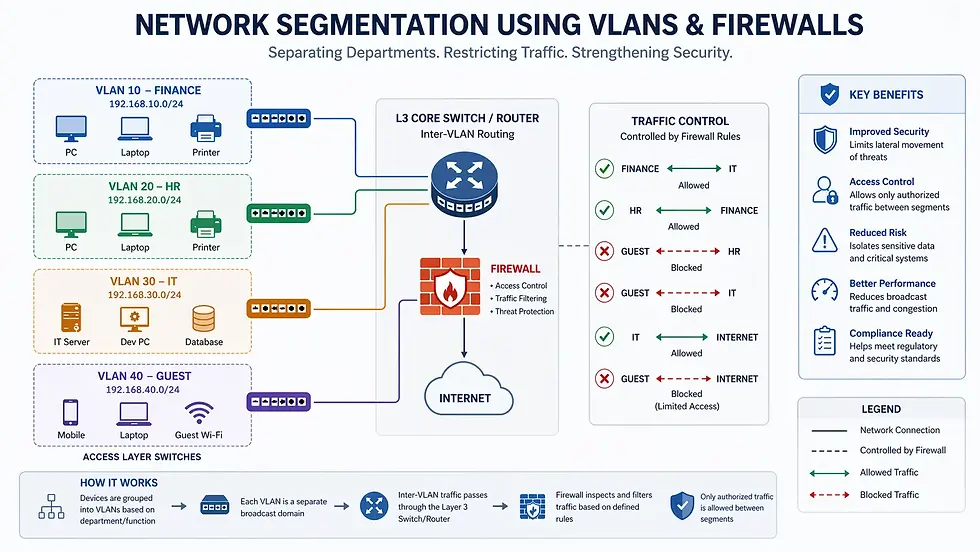
Devices are grouped into segments
Rules define allowed communication
Traffic between segments is filtered and controlled
Common Segmentation Strategies
Below are some widely used segmentation strategies that help organize networks efficiently while enhancing security and control.
Department-Based Segmentation
HR, Finance, IT separated
This ensures each department’s data stays isolated and secure from others
Function-Based Segmentation
Servers, user devices, IoT devices separated
This groups systems based on their role to reduce risk and improve control
Security-Level Segmentation
High-risk vs low-risk systems
This limits exposure by isolating critical systems from vulnerable ones
Guest Network Segmentation
Guests isolated from internal network
This prevents external users from accessing sensitive internal resources
Real-World Example
A small office network might look like this:
VLAN 10 → Employees
VLAN 20 → Servers
VLAN 30 → Guest Wi-Fi
VLAN 40 → IoT devices
Rules:
Employees → can access servers
Guests → internet only
IoT → restricted access
👉 Even if a smart device is compromised, it can’t reach critical systems.
Best Practices for Network Segmentation
Follow these best practices to implement network segmentation effectively while maintaining security, performance, and scalability.
Plan Before You Implement
Map devices and data flow
Identify sensitive systems
Define clear segmentation goals and policies
Apply Least Privilege Access
Only allow necessary communication
Restrict access based on user roles and device types
Use Firewalls Between Segments
Don’t rely only on VLAN separation
Implement strict access control rules between segments
Monitor Traffic Continuously
Detect unusual behavior early
Use logging and alert systems for real-time visibility
Document Everything
Keep track of segment rules and structure
Regularly update documentation after any network changes
Common Mistakes to Avoid
Over-segmentation (too complex to manage)
No proper access rules
Ignoring internal threats
Poor documentation
Not testing segmentation policies
Network Segmentation vs Microsegmentation
👉 Microsegmentation is more precise but harder to implement.
Feature | Segmentation | Microsegmentation |
Scope | Network level | Application/workload level |
Complexity | Moderate | High |
Control | Group-based | Granular |
When Should You Use Network Segmentation?
You should implement segmentation if:
You run an online business
You handle sensitive data
You have multiple users/devices
You use cloud or hybrid infrastructure
👉 Even small networks benefit from basic segmentation.
Closing Notes
Network segmentation is not just a “big enterprise” concept, it’s a practical, essential strategy for any modern network. It improves:
Security
Performance
Control
Reliability
👉 In simple terms: Segmentation turns your network from a wide-open space into a controlled, secure environment. And in today’s threat landscape, that’s not optional - it’s necessary.
Author: Kalyan Bhattacharjee
Category: Cybersecurity | Network and Internet | Tech Learning
Expertise: Technology Analyst & Digital Research Writer | 5+ Years of Experience
Source: Research-based content using publicly available technical resources and industry references
📚 Keep exploring - Here are more tech blogs you’ll love:


Comments