
What Is Spatial Computing? The Tech That’s Reshaping VR and AR

Updated: Jul 12

Introduction | Spatial Computing
Virtual Reality (VR) and Augmented Reality (AR) have evolved significantly over the past decade. However, a new term has increasingly entered technology discussions: Spatial Computing. Often described as the next step beyond traditional VR and AR, spatial computing enables computers to understand and interact with the physical world in a much more natural and intelligent way.
From immersive headsets and smart glasses to industrial automation and digital twins, spatial computing is rapidly becoming one of the most important emerging technologies of the decade. In this guide, we'll explore what spatial computing is, how it works, its real-world applications, and why many experts believe it could reshape the future of human-computer interaction.
What Is Spatial Computing?
Spatial computing refers to technology that enables computers to understand, interpret, and interact with physical space. Instead of limiting interactions to traditional screens, keyboards, and touch interfaces, spatial computing allows digital content to exist and respond within real-world environments.
In simple terms, it merges:
Physical spaces
Digital objects
Sensors
Artificial Intelligence (AI)
Computer vision
Real-time data processing
The goal is to make digital experiences feel naturally integrated into the real world.
Why Is It Called "Spatial" Computing?
The term "spatial" refers to space and location. Traditional computing mainly operates on flat screens, while spatial computing understands:
Depth
Distance
Position
Movement
Surroundings
This enables devices to recognize where objects, people, and surfaces exist within a three-dimensional environment. For example, a virtual monitor could remain fixed on a specific wall in your room, even as you walk around it.
How Does Spatial Computing Work?
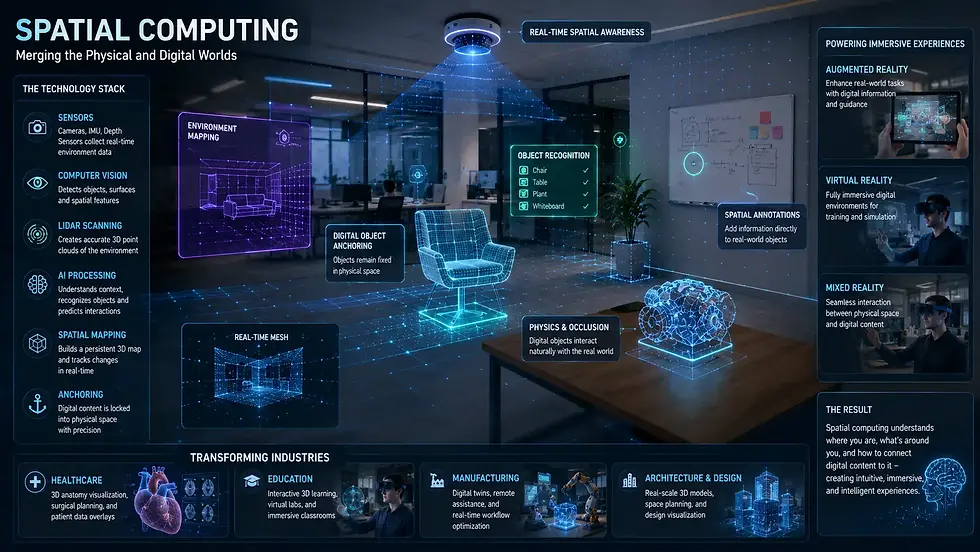
Spatial computing combines multiple technologies working together. Core components include:
Sensors
Devices use sensors to collect information about the surrounding environment.
Examples include:
Cameras
LiDAR scanners
Depth sensors
Motion sensors
GPS modules
Computer Vision
Computer vision helps systems interpret visual information captured by cameras. This allows devices to:
Recognize objects
Detect surfaces
Track movement
Identify people and gestures
Artificial Intelligence
Artificial intelligence processes environmental data and helps systems make intelligent decisions in real time. Examples include:
Object recognition
Gesture detection
Predictive analysis
Voice commands
Virtual object placement
Spatial Mapping
Spatial mapping creates a digital representation of physical environments, allowing virtual content to interact realistically with the real world.
This enables systems to:
Map rooms and spaces
Detect walls and surfaces
Identify furniture and obstacles
Measure distances
Anchor virtual objects accurately
Real-Time Processing
Real-time processing continuously updates the system's understanding of the environment as users move and interact with digital content.
Key functions include:
Instant environment updates
Motion tracking
Low-latency rendering
Position synchronization
Dynamic object interaction
How Spatial Computing Differs From VR and AR
Many people assume spatial computing is simply another name for VR or AR. While related, the concepts are not identical.
Technology | Primary Purpose |
Virtual Reality (VR) | Creates fully virtual environments |
Augmented Reality (AR) | Overlays digital content onto the real world |
Spatial Computing | Enables digital systems to understand and interact with physical space |
Think of VR and AR as applications, while spatial computing is the broader technological framework that makes advanced immersive experiences possible.
Key Features of Spatial Computing
From environmental awareness to real-time interaction, spatial computing relies on several key technologies to deliver immersive experiences.
Environment Awareness
Spatial computing systems understand the layout of physical spaces. This enables more realistic and context-aware interactions.
Natural User Interaction
Instead of relying solely on keyboards or touchscreens, users can interact through:
Hand gestures
Eye tracking
Voice commands
Body movement
Persistent Digital Objects
Virtual objects can remain anchored to specific physical locations. This creates more realistic and useful mixed-reality experiences.
Real-Time Adaptation
Spatial systems continuously update based on user movement and environmental changes.
Multi-Device Integration
Spatial experiences can often extend across multiple devices and platforms simultaneously.
Real-World Applications of Spatial Computing
The technology extends far beyond gaming and entertainment.
Education
Students can interact with 3D models, virtual laboratories, and immersive learning environments. Complex concepts become easier to visualize and understand. This hands-on approach can improve engagement, knowledge retention, and overall learning outcomes.
Healthcare
Doctors and surgeons can use spatial computing for:
Surgical planning
Medical visualization
Remote collaboration
Training simulations
Manufacturing
Factories increasingly use spatial computing to:
Monitor equipment
Improve workflows
Train employees
Visualize production systems
Architecture and Design
Architects can walk through virtual building designs before construction begins. This improves planning and reduces costly mistakes. It also enables better collaboration between architects, engineers, and clients during the design process.
Retail
Customers can preview products within their homes before purchasing. Virtual showrooms and immersive shopping experiences are becoming more common.
Gaming
Gaming remains one of the most visible applications. Players can interact with virtual worlds more naturally through motion tracking, gesture controls, and immersive mixed-reality experiences.
Entertainment
Spatial computing can create highly immersive experiences where digital content interacts naturally with real-world environments. This technology is transforming how people experience movies, live events, virtual concerts, and interactive storytelling.
The Role of AI in Spatial Computing
Artificial Intelligence plays a crucial role in modern spatial computing systems. AI helps devices:
Understand environments
Recognize objects
Track user behavior
Predict movements
Improve interaction accuracy
Without AI, many advanced spatial experiences would feel far less intelligent and responsive. As AI continues to improve, spatial computing systems are expected to become significantly more capable.
Popular Devices Using Spatial Computing
Several modern devices already incorporate spatial computing technologies.
Examples include:
Mixed-reality headsets
AR smart glasses
Industrial visualization systems
Autonomous robots
Smart manufacturing platforms
Many of today's advanced XR (Extended Reality) devices rely heavily on spatial computing principles.
Challenges Facing Spatial Computing
Despite its promise, the technology still faces several obstacles.
Hardware Costs: Advanced sensors and processing systems can be expensive.
Battery Life: Real-time environmental analysis requires substantial computing power.
Privacy Concerns: Spatial devices often collect large amounts of environmental and visual data. Proper privacy protections remain an important challenge.
Processing Requirements: Accurately mapping and understanding physical spaces demands significant computational resources.
User Adoption: Many consumers are still unfamiliar with spatial computing concepts and devices.
Why Spatial Computing Matters
The significance of spatial computing extends beyond immersive entertainment. Many experts believe it represents a fundamental shift in how humans interact with digital systems. Rather than adapting ourselves to computers, future systems may increasingly adapt to us and our physical surroundings.
This Could Make Technology:
More intuitive
More immersive
More efficient
More context-aware
In many ways, spatial computing aims to blur the boundary between digital and physical worlds.
Future Trends in Spatial Computing
Over the next decade, we may see:
Lighter mixed-reality headsets
More advanced smart glasses
Improved AI integration
Better spatial mapping
Faster processors
Increased enterprise adoption
As hardware improves and costs decrease, spatial computing could become as commonplace as smartphones are today.
Key Takeaways
Spatial computing is an emerging technology that enables computers to understand and interact with physical environments in real time. By combining sensors, AI, computer vision, and spatial mapping, it creates more natural and immersive digital experiences that go far beyond traditional screens.
While closely connected to VR and AR, spatial computing represents a broader technological shift that could transform industries ranging from healthcare and education to manufacturing and entertainment. As the technology matures, it may fundamentally change how people interact with computers and digital information in everyday life.
Author: Kalyan Bhattacharjee
Category: Latest Technologies | Machine Learning | Tech Reviews
Expertise: Technology Analyst & Digital Research Writer
Source: Research-based content using publicly available technical resources and industry references
📚 Keep exploring - Here are more tech blogs you’ll love:
Related Keywords: what is spatial computing, spatial computing news, spatial computing companies, vr computing, spatial computer, spatial computing courses, spatial computing explained, spatial computing technology, vr and ar technology, mixed reality, computer vision, ai and spatial computing, extended reality (XR), future of computing, immersive technology. fintech shield


Comments