
Microcontroller vs Microprocessor: What’s the Difference? (Simple Guide)

Updated: Sep 16

A Closer Look | Microcontroller vs Microprocessor
If you’re getting into electronics or embedded systems, you’ll quickly run into two terms that sound similar but serve very different roles: microcontroller and microprocessor. Both are essential in modern technology. Both process data. But they are built for completely different purposes.
Let’s break it down clearly, no unnecessary complexity.
What Is a Microcontroller?
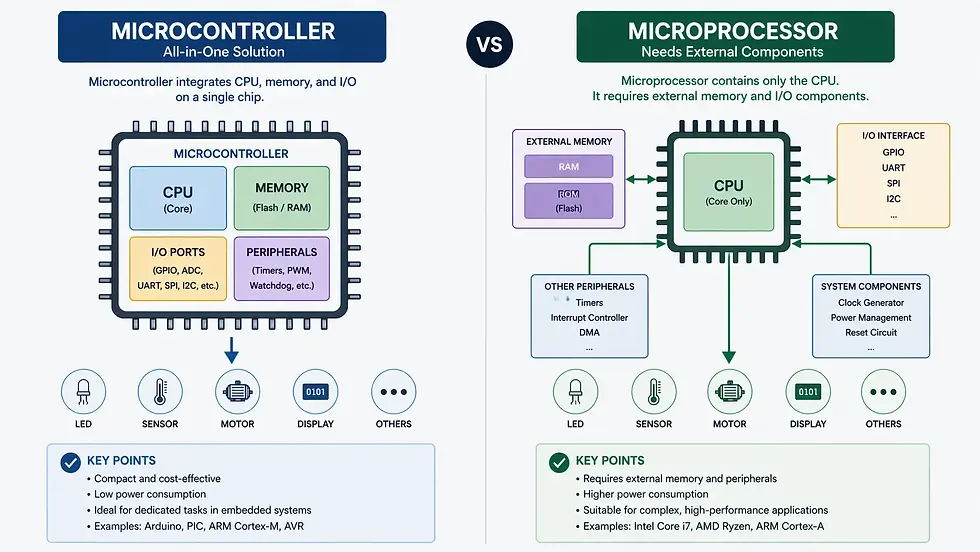
A microcontroller is a compact integrated circuit designed to perform specific tasks within a device. 👉 Think of it as a small, self-contained computer on a single chip.
It typically includes:
CPU (processor core)
Memory (RAM + Flash)
Input/Output (I/O) ports
Timers and peripherals
Where microcontrollers are used:
Washing machines
Microwave ovens
IoT devices
Remote controls
Embedded systems
👉 Microcontrollers are designed for control and automation tasks.
What Is a Microprocessor?
A microprocessor is a central processing unit (CPU) designed for general-purpose computing. 👉 It focuses only on processing other components are external.
It requires:
External RAM
External storage
External I/O components
Where microprocessors are used:
Desktop computers
Laptops
Servers
Smartphones (advanced SoCs)
👉 Microprocessors are built for complex, multi-tasking environments.
Key Differences: Microcontroller vs Microprocessor
While both process data, their architecture, functionality, and use cases differ significantly based on whether the task is specialized or general-purpose.
Design Approach
Microcontroller: All-in-one system
Microprocessor: CPU only (needs external components)
Purpose
Microcontroller: Dedicated task
Microprocessor: General-purpose computing
Power Consumption
Microcontroller: Low power
Microprocessor: Higher power usage
Cost
Microcontroller: Affordable
Microprocessor: More expensive (due to extra components)
Performance
Microcontroller: Moderate performance
Microprocessor: High performance
Applications
Microcontroller: Embedded systems
Microprocessor: Computers and complex systems
Simple Analogy
Think of it like this:
Microcontroller = A dedicated machine (like a washing machine doing one job)
Microprocessor = A full computer (like a PC handling multiple tasks)
Real-World Examples | Microcontroller vs Microprocessor
Looking at real-world devices helps clearly illustrate how microcontrollers and microprocessors are used in different practical scenarios.
Microcontroller Example
Arduino board
Controls LEDs, sensors, motors
Microprocessor Example
Laptop CPU
Runs operating systems and applications
Which One Should You Use?
It depends on your goal.
👉 Use a Microcontroller if:
You’re building embedded systems
You need low power consumption
You’re working on automation or IoT
👉 Use a Microprocessor if:
You need high performance
You’re running complex software
You’re building full computing systems
Do Smartphones Use Microcontrollers or Microprocessors?
Modern smartphones use both.
A powerful microprocessor (SoC) handles apps and OS
Multiple microcontrollers manage sensors, battery, and background tasks
Common Misconceptions
Clearing up these misconceptions helps you better understand their distinct roles and choose the right component for the right application.
They are the same thing: They are fundamentally different in design and purpose.
Microcontrollers are outdated: They are widely used in modern devices and IoT systems.
Microprocessors are always better: Not true, they’re just designed for different tasks.
Key Takeaways
Microcontrollers and microprocessors may sound similar, but they solve different problems.
👉 Microcontrollers are efficient, focused, and ideal for embedded tasks.
👉 Microprocessors are powerful, flexible, and designed for full-scale computing.
Understanding this difference is essential if you’re working in electronics, embedded systems, or even just trying to understand how devices around you work.


Comments